
BREEAM HEA 05 Acoustic Performance Explained
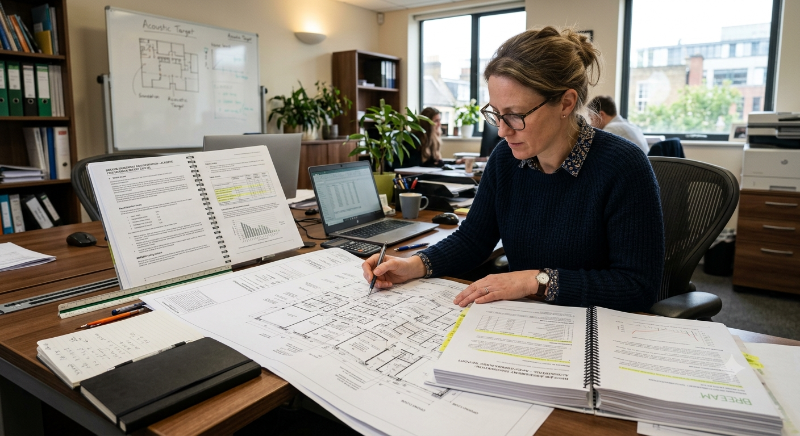
BREEAM HEA 05 acoustic credits are missed more often than a building’s actual performance would warrant. The most common cause is not a poorly built wall, but a procedural error: appointing the acoustic consultant too late, or misunderstanding the exact evidence requirements.
HEA 05 (Acoustic Performance) sits within the Health and Wellbeing category. In most BREEAM schemes, it is a mandatory issue. This means the minimum prerequisite must be satisfied early in the design phase, or you cannot claim any acoustic credits at all—even if the completed building performs flawlessly.
What BREEAM HEA 05 Covers
Depending on your building type and BREEAM scheme (New Construction, Refurbishment & Fit-Out, or Domestic), the credit assesses up to three distinct acoustic domains:
- Sound Insulation: The performance of walls, floors, and facades in blocking sound between spaces or from external environment sources.
- Indoor Ambient Noise Levels: Background noise within occupied rooms caused by building services (HVAC, ventilation plant, lifts) and external traffic.
- Reverberation Time: How sound echoes and decays within a room. This is critical for speech intelligibility in classrooms, open-plan offices, and healthcare spaces.
Target Standards by Building Type
Acoustic requirements are highly specific and vary drastically by sector. The primary target frameworks include:
- Residential New-Builds: Referenced against Approved Document E sound insulation baselines and BS 8233 internal noise criteria.
- Schools & Education: Evaluated strictly against the comprehensive criteria of Building Bulletin 93 (BB93).
- Healthcare & NHS Buildings: Governed by the detailed room-by-room requirements of HTM 08-01.
- Commercial Offices: Assessed primarily against BS 8233 ambient noise targets and professional reverberation guidelines.
The Suitably Qualified Person (SQP) Requirement
To secure HEA 05 credits, your acoustic strategy and testing must be produced or supervised by a Suitably Qualified Person (SQP).
BREEAM defines an SQP as an acoustic practitioner with recognized professional qualifications, typically holding Full or Associate membership in the Institute of Acoustics (IOA).
Critical Timing: The SQP must be appointed during RIBA Stage 2 (Concept Design). If a consultant is engaged later at Stage 4—after structural, facade, and mechanical layouts are already finalized—the design-stage credit is often permanently lost because the strategy could not meaningfully influence the building's design.
Why HEA 05 Credits Are Commonly Lost
Most BREEAM acoustic credit failures are entirely preventable and stem from a few common project management oversights:
- Late Appointment: Engaging the acoustic consultant after major architectural and HVAC decisions are locked.
- Unverified Credentials: Assuming any noise surveyor is an approved BREEAM SQP without verifying IOA membership beforehand.
- Scope Omissions: Forgetting to include post-completion reverberation or building services commissioning tests in the initial specialist appointment.
- Wrong Documentation: Submitting a standard planning stage noise assessment instead of a dedicated, credit-specific BREEAM Acoustic Strategy report.
Managing the Evidence Window
Securing the final credits requires a clean, two-step evidence trail mapped to your project timeline:
- Design-Stage Evidence: A comprehensive acoustic strategy report delivered by the SQP during RIBA Stage 2 or early Stage 3, establishing targets and design methods before final drawings are signed off.
- Post-Completion Evidence: In-situ sound insulation testing, reverberation surveys, and plant noise commissioning measurements completed by the SQP before the final BREEAM certificate is issued.
Conclusion
BREEAM HEA 05 compliance is easily achievable when integrated early. Ensuring you have an IOA-qualified professional on board during the concept design stage guarantees you satisfy the mandatory prerequisites and protect your target credits without late-stage stress or costly structural remediation.
Our experienced consultants are full members of the Institute of Acoustics (IoA). Contact EMC Acoustics today to map out the exact HEA 05 strategy, evidence formats, and program milestones required for your upcoming BREEAM project

More from our experts
Explore recent articles on acoustic engineering and design