
BS 4142 Noise Assessment: What It Is and When You Need One
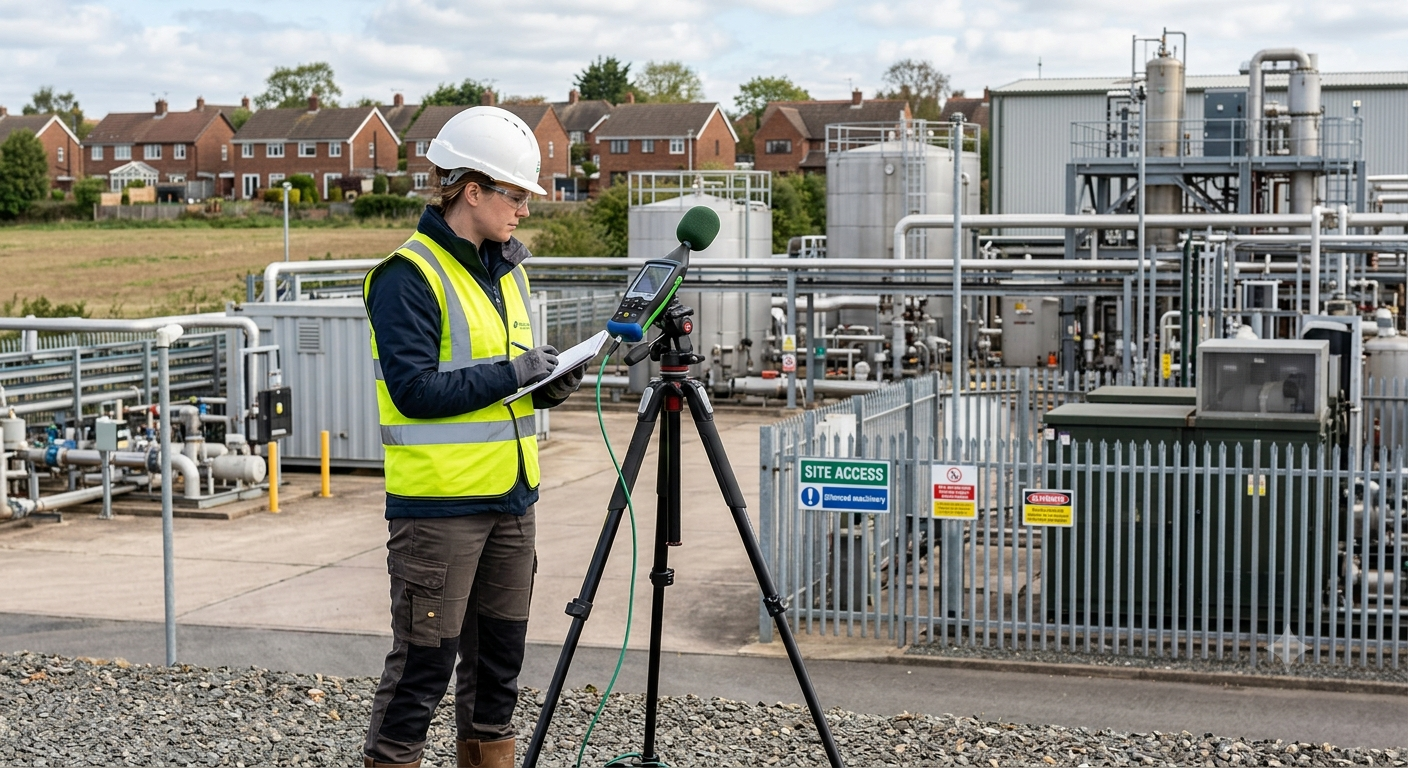
Most planning applications involving commercial or industrial noise will, at some point, require a BS 4142 assessment. It is the standard Local Planning Authorities (LPAs) use to judge whether a noise source will adversely affect nearby residents. This process works in both directions: assessing a new development generating noise near existing housing, or evaluating proposed housing in an environment dominated by existing commercial noise.
This article explains what BS 4142 measures, how the assessment is structured, which planning scenarios trigger a requirement, and what the submitted report needs to contain.
What Is BS 4142?
BS 4142 (Methods for rating and assessing industrial and commercial sound) is the standard used by local authorities to evaluate the impact of noise from commercial and industrial sources on noise-sensitive receptors. In most planning contexts, those receptors are residential properties, though schools and hospitals are also considered.
The assessment compares two key figures: the rating level of the noise source and the background noise level at the receptor.
The rating level starts as the noise level from the source at the receptor. A character correction penalty of up to plus 5 dB is applied if the noise has prominent tonal, impulsive, or intermittent characteristics, reflecting that these acoustic features make noise more intrusive than continuous sound.
This corrected rating level is compared against the background noise level, expressed as the LA90—the level exceeded for 90 percent of the measurement period. The difference determines the likely significance of the impact:
- 10 dB or more above background: Indicates a significant adverse impact is likely.
- Approximately equal to background: Indicates an adverse impact is likely.
- Below background: Indicates a minimal impact is likely.
A significant adverse finding does not automatically mean refusal. It is a material consideration weighed by the planning authority against the benefits of the development and the scope for mitigation.
When Is a BS 4142 Assessment Required?
There is no single rule that automatically triggers the requirement. Planning authorities exercise judgment, and the need for a BS 4142 assessment is usually confirmed at the pre-application stage. In practice, an assessment is expected in the following common scenarios:
- New commercial or industrial development near existing housing: Any project introducing a new noise source—such as rooftop HVAC plant, refrigeration units, ventilation systems, generator sets, or delivery activity—will need an assessment.
- New residential development near existing commercial premises: Where housing is proposed adjacent to an industrial estate, retail park, or food premises, BS 4142 determines whether the existing noise environment is suitable for future occupants.
- Change of use applications: Converting commercial premises to residential use typically requires an assessment if there are active background noise sources nearby.
- Discharge of acoustic planning conditions: Where consent has been granted with a condition restricting plant noise to a specific level, a post-installation assessment demonstrates compliance so the condition can be discharged.
How Is the Assessment Carried Out?
The assessment follows three clean stages:
- Background Noise Survey: The LA90 background level is measured near the nearest noise-sensitive receptor, typically using an unattended calibrated sound level meter over 24 to 72 hours. Night-time background levels are assessed separately, as background noise is generally lower at night, making impact thresholds harder to meet.
- Source Noise Characterisation: The specific noise level of the source is either measured directly on site or predicted using manufacturer acoustic data and international propagation standards (such as ISO 9613-2) for plant not yet installed.
- Rating Level Calculation: Character corrections are applied where the noise warrants them, the final rating level is compared against the background, and the impact significance is documented for daytime, evening, or night-time periods.
What Acoustic Consultants Provide
For a planning application requiring a BS 4142 assessment, the acoustic consultant delivers a comprehensive report that must explicitly "show its working" to prevent delays from local Environmental Health teams. The consultant typically provides:
- A background noise survey programme with calibration records and an agreed assessment position.
- Source noise characterisation using measurement data, manufacturer performance figures, or noise propagation modelling.
- Rating level calculations for each source with explicit justification for any character corrections applied.
- Advanced noise contour modelling where the source affects multiple receptors or complex propagation paths.
- A final report formatted for LPA submission, containing methodology, survey results, impact conclusions, and a detailed noise mitigation specification if required.
Early agreement on the survey methodology with the Local Planning Authority before surveys are carried out is the most effective way to prevent costly rewrites or repeat monitoring programmes.
Key Takeaways
- BS 4142 is the standard Local Planning Authorities use to assess the impact of industrial and commercial noise on sensitive receptors.
- The assessment applies in two directions: new noise sources near existing housing, or proposed housing affected by existing commercial noise.
- The rating level adjusts the source noise level for intrusive characteristics, which is then compared directly against the measured LA90 background level.
- A rating level 10 dB or more above the background indicates a likely significant adverse impact, while a level below background indicates a minimal impact.
- Pre-application agreement on methodology with the local authority before site surveys begin prevents the most common causes of planning delays.
Conclusion
BS 4142 assessments are standard across a wide range of commercial, industrial, and residential planning applications, and the requirement can usually be identified before a pre-application is submitted. A well-scoped assessment, with surveys carried out during the relevant periods and methodology agreed with the planning authority in advance, gives a planning application the acoustic evidence it needs to be determined without delay.
Contact EMC Acoustics to discuss whether your planning application requires a BS 4142 assessment and what information is needed to scope the work.

More from our experts
Explore recent articles on acoustic engineering and design