
Part E of the Building Regulations Explained: How to Safeguard Your Project from Sound Test Failures
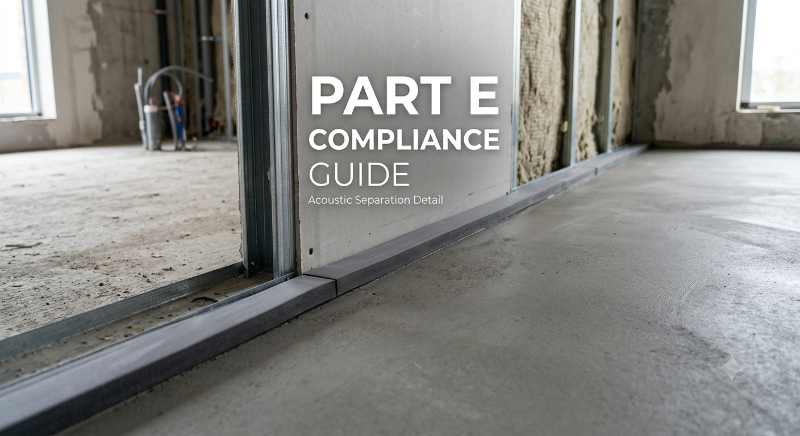
Pre-completion sound insulation testing is often the exact moment a developer encounters Part E of the Building Regulations—usually when it's too late. With walls sealed and screeds poured, a failed test means expensive delays and tearing up finished work.
Part E enforces strict minimum sound insulation standards between residential dwellings in England and Wales. Here is how to navigate the regulation, choose your compliance route, and protect your margins.
The Scope of Part E
Part E applies strictly to three categories of construction:
- New-Build Dwellings: Purpose-built flats, houses, and mixed-use spaces.
- Residential Conversions: Subdividing homes or converting commercial offices into apartments.
- Schools: Governed specifically by Building Bulletin 93 (BB93).
(Jurisdictional Note: Part E applies to England and Wales only. It does not regulate standard commercial offices, hotels, or care homes).
Mandatory Performance Thresholds
Acoustic compliance is calculated using two simple metrics: Airborne Sound (attenuation of speech and music) and Impact Sound (footsteps and structural vibration through floors).
The exact legal performance requirements on site are broken down by project type below:
For New-Build Projects
- Separating Walls: Must achieve an airborne insulation level of 45 dB or higher.
- Separating Floors: Must achieve an airborne insulation level of 45 dB or higher.
- Floor Impact Sound: Must limit structural noise transmission to 62 dB or lower.
For Conversion Projects
- Separating Walls: Must achieve an airborne insulation level of 43 dB or higher.
- Separating Floors: Must achieve an airborne insulation level of 43 dB or higher.
- Floor Impact Sound: Must limit structural noise transmission to 64 dB or lower.
The Golden Rule: Never design your project to hit these minimums exactly. Field measurements carry inherent site variability. Always specify an acoustic safety margin comfortably above the legal minimum to absorb workmanship inconsistencies.
Two Routes to Compliance
Developers have two distinct pathways to secure Building Control sign-off:
- Robust Details (No Testing): You bypass pre-completion testing by registering your plot and using a pre-approved construction detail from the official handbook. The Risk: It must be built with absolute, flawless precision on site. Any deviation at a structural junction or material substitution invalidates the exemption.
- Project-Specific Specification (Testing Required): An acoustic consultant engineers a bespoke design tailored to your layout, which is then validated through physical on-site testing. This is the standard, mandatory path for conversions and high-end schemes aiming for BREEAM credits.
The Hidden Threat: Flanking Transmission
Most test failures are not caused by bad wall specifications, but by flanking transmission—sound bypassing the separating element through structural connections rather than passing through it.
Common flanking paths include:
- Continuous floor screeds running directly under a separating wall.
- Joists or beams bearing onto walls without proper acoustic isolation.
- Unsealed MEP services penetrations leaking airborne sound.
- Acoustic resilient layers or flanking strips damaged during the screed pour.
Because flanking transmission is completely invisible once construction is complete, identifying it post-test requires invasive, costly remediation.
Secure Your Part E Sign-Off
A failed test halts handovers and blocks legal sign-offs. Early acoustic design and regular site monitoring are dramatically cheaper than late-stage remediation.
Our experienced consultants are full members of the Institute of Acoustics (IoA). Whether you need a project-specific acoustic specification, on-site monitoring, or accredited pre-completion testing, contact EMC Acoustics today to discuss your project requirements.

More from our experts
Explore recent articles on acoustic engineering and design