
Reverberation Time Explained: What It Is and Why It Matters
The acoustic performance of a room is not determined by its construction quality alone. A structurally sound building with no external noise problems can still be acoustically inadequate if its reverberation time is too long. This issue is the source of more acoustic complaints in occupied buildings than most clients expect.
Excessive reverberation makes speech difficult to follow, raises perceived noise levels, and causes listening fatigue. In schools and healthcare facilities, it has direct consequences for the quality of the environment a building is intended to deliver.
This article explains what reverberation time is, how it is measured, why it matters, and what acoustic consultants do to control it.
What Is Reverberation Time?
Reverberation time is the time, in seconds, required for sound in a room to decay by 60 dB after the source stops. This is commonly referred to as RT60.
In practice, measuring a full 60 dB decay is not always possible in noisy environments, so the decay is measured over a shorter range and extrapolated. The T20 method measures the decay between 5 dB and 25 dB below the initial level, while the T30 method evaluates the portion between 5 dB and 35 dB.
Reverberation time varies significantly with frequency. Results are expressed at octave band centre frequencies—typically from 125 Hz to 4 kHz. The average of the 500 Hz and 1 kHz values serves as the primary single-figure descriptor for comparison against design criteria. A longer reverberation time means sound lingers, while a shorter time results in an acoustically "dry" room. The ideal target depends entirely on how the space is used.
Why Does Reverberation Time Matter?
Speech Intelligibility
In highly reverberant rooms, sound from earlier syllables overlaps with subsequent speech before the human ear can process it. Consonants, which distinguish words from one another, are masked by the sustained decay of vowels.
This makes verbal communication central to the function of the room effortful. If a classroom fails to meet its BB93 reverberation targets, the acoustic environment actively impairs learning.
Noise Levels and Occupant Comfort
Reverberant rooms are naturally louder rooms. When every sound source is accompanied by its own sustained decay, the cumulative noise level escalates.
Offices, restaurants, and open-plan workspaces that are acoustically hard feel chaotic, forcing occupants to raise their voices. This cycle of rising noise is known as the Lombard effect. Controlling reverberation time is the most direct way to reduce perceived noise levels without changing the underlying noise sources.
How Is Reverberation Time Measured?
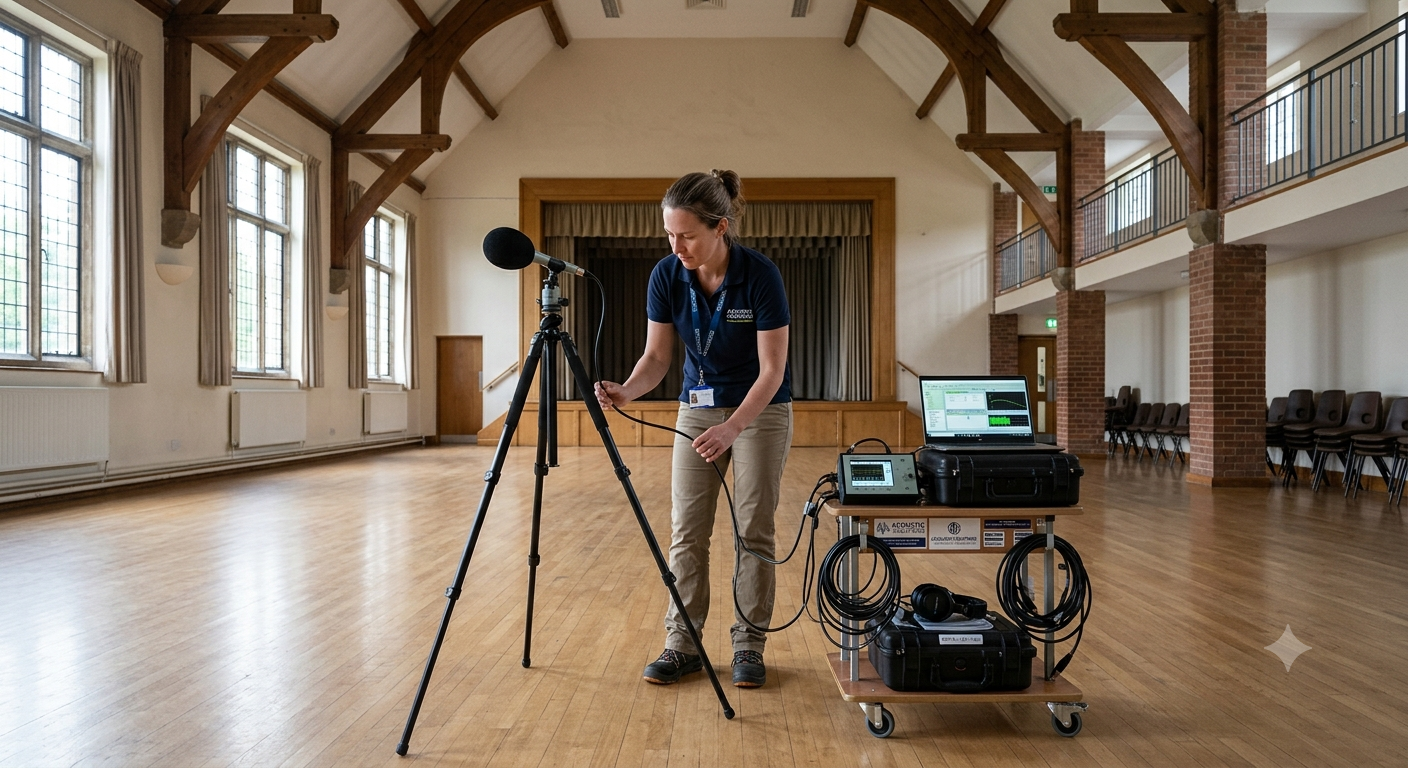
Reverberation time is measured in-situ within the completed room using the methods defined in BS EN ISO 3382-1 for performance spaces and BS EN ISO 3382-2 for general occupied rooms like offices and classrooms.
Measurements use either a calibrated loudspeaker generating broadband noise that is abruptly cut, or an impulsive source such as a starting pistol. Sound level meters record the decay curve to calculate T20 or T30 across multiple averaged positions.
Surveys are carried out in the unoccupied building with furniture in place, as furniture adds absorption. These post-construction reverberation surveys confirm compliance for BREEAM HEA 05 submissions and planning condition discharge.
Typical Reverberation Time Targets
Design ranges vary drastically depending on room volume, occupancy, and specific use. The governing standards establish distinct mid-frequency target windows for different building sectors:
- Primary School Classrooms (BB93): Targets approximately 0.4 to 0.6 seconds to ensure high speech clarity for young learners.
- Secondary School Classrooms (BB93): Targets approximately 0.6 to 0.8 seconds.
- School Sports Halls (BB93): Allows a longer range of approximately 1.0 to 1.5 seconds due to the large volume.
- NHS Consulting Rooms (HTM 08-01): Requires a controlled 0.4 to 0.6 seconds for medical privacy and clear communication.
- NHS Wards & Patient Areas (HTM 08-01): Targets approximately 0.6 to 0.8 seconds to balance comfort and clinical practicality.
- Open-Plan Offices (BS 8233): Designed to a dry 0.3 to 0.5 seconds to minimize distractions across workstations.
- Meeting & Conference Rooms (BS 8233): Targets 0.4 to 0.6 seconds for clear physical and teleconferencing audio.
- Theatres & Lecture Auditoria (BS EN ISO 3382-1): Targets 0.8 to 1.2 seconds to amplify vocal projection naturally.
- Orchestral Concert Halls (BS EN ISO 3382-1): Requires a rich, blended sound, targeting a long 1.6 to 2.2 seconds.
How to Improve Reverberation Time
Reverberation time is a direct product of a room's volume and the total sound absorption present on its surfaces. Most rooms fail because hard primary surfaces—like concrete ceilings or glazed walls—reflect sound. Adding a calculated acoustic treatment specification brings the space into compliance. Common interventions include:
- Acoustic Ceiling Panels or Tiles: The most effective single intervention, as ceilings represent the largest accessible reflective surface.
- Wall-Mounted Acoustic Panels: Used where ceiling mounting is restricted or to prevent flutter echoes between parallel walls.
- Suspended Acoustic Baffles: Ideal for high-ceiling spaces like sports halls and canteens where surface mounting is impractical.
- Soft Floor Finishes: Premium carpets provide meaningful high-frequency absorption routinely utilized in commercial and healthcare spaces.
The exact quantity of absorption required must be derived using the Sabine or Eyring formula. Relying on guesswork often leads to under-specifying or over-spending. Utilizing advanced 3D acoustic modelling allows specifiers to accurately predict and adjust treatment layouts before materials are purchased.
Key Takeaways
- Reverberation time (RT60) is the number of seconds required for sound to decay by 60 dB. The 500 Hz and 1 kHz average serves as the primary design benchmark.
- Excessive reverberation degrades speech clarity, drives up background noise via the Lombard effect, and causes occupant fatigue.
- Targets are strictly sector-dependent, governed by BB93 for education, HTM 08-01 for healthcare, and BS 8233 for commercial offices.
- Post-construction surveys verify compliance for BREEAM and planning conditions under BS EN ISO 3382-2.
- Successful remediation requires a calculated treatment area based on room volume and material absorption coefficients.
Conclusion
Reverberation time is the most commonly specified room acoustic parameter and the most commonly underestimated one. Getting it right depends on the treatment specification being derived from calculation rather than assumption and on the specification being coordinated with the architectural design before finishes are fixed.
Contact EMC Acoustics to discuss reverberation time targets for your project, or to commission a post-construction reverberation survey for a completed building

More from our experts
Explore recent articles on acoustic engineering and design