
3D Room Acoustics Modelling
Room acoustic properties are determined primarily by decisions made at the design stage, including room geometry, surface areas and material absorption coefficients; modelling those decisions before construction eliminates the risk of an expensive post-completion acoustic treatment programme.
Room Acoustics Modelling — What It Involves
The acoustic performance of a room is largely fixed by its geometry and surface finishes, both of which are much easier to adjust during design than after construction. A lecture theatre with excessive reverberation, a concert hall with uneven sound distribution or a classroom that fails BB93 criteria all require expensive and disruptive retrofit treatment that geometric modelling at design stage would have avoided.
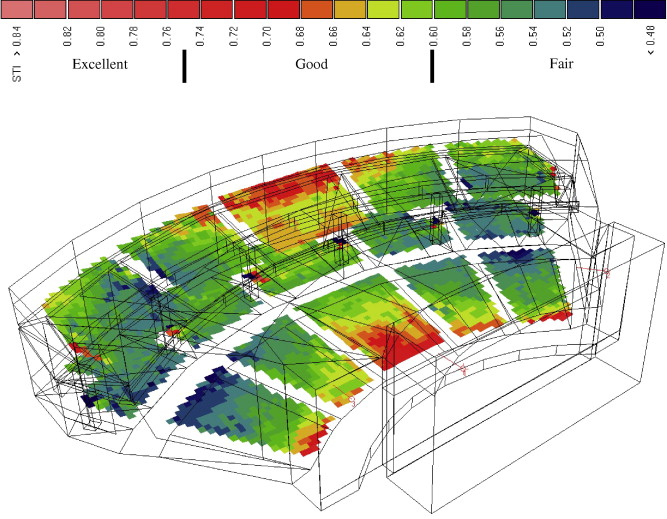
Room acoustics modelling involves building a 3D geometric model of the proposed space and assigning measured absorption and scattering coefficients to each surface material. Specialist acoustic software calculates the reverberation time at octave band frequencies, the strength and direction of early reflections and late reverberation energy, and room acoustic quality parameters defined by ISO 3382-1 for concert auditoria and ISO 3382-2 for everyday spaces, including clarity, definition, early decay time and strength G.
Why is room acoustics modelling important?
Design stage prediction
Reverberation time and room acoustic parameters can be predicted accurately using geometric simulation before a brick is laid or a tile is fixed. Modelling at design stage allows architects and acoustic consultants to evaluate alternative material and geometry options against the performance target and agree a specification that is confident to achieve it, rather than discovering shortfalls after construction.
Treatment specification
The model calculates the precise additional absorption area, at each octave band, needed to bring the predicted reverberation time within the target range. This allows acoustic treatment to be specified by area, type and location rather than by rule of thumb, avoiding both under-specification, which fails the acoustic target, and over-specification, which wastes budget.
Alternative option comparison
Multiple design options, including different ceiling geometries, surface material selections, balcony configurations and treatment layouts, can be modelled and compared before any commitment to a specification. This makes the model a design decision tool rather than simply a compliance check, and allows the acoustic consultant to engage directly with the architect's aesthetic intent.
Post-construction verification
Three-dimensional acoustic modelling at design stage identifies deficiencies in room geometry, volume and surface specification before construction begins. Retrofitting acoustic treatment after handover to correct an underperforming room is significantly more expensive than specifying correctly at the outset, and in fixed-dimension spaces — auditoria, lecture theatres, sports halls — some acoustic quality parameters cannot be recovered at all once the structure is built and the geometry is set.
What acoustic standards apply to room acoustics modelling?
Room acoustic performance is assessed against standards that set criteria for reverberation time and related parameters by space type. BS EN ISO 3382-1:2009 provides measurement methods for auditoria and performance spaces; BS EN ISO 3382-2:2008 covers offices, classrooms and general occupied rooms. For school buildings, Building Bulletin 93 (BB93) specifies reverberation time targets for each teaching space type. For NHS and private healthcare facilities, HTM 08-01 sets reverberation criteria for clinical and patient-facing spaces.
Three-dimensional acoustic modelling provides predicted values for these parameters before construction, enabling specifiers to verify compliance before materials are committed. Models are calibrated to published material absorption data and, where existing spaces are being refurbished, validated against in-situ survey results. Predicted outcomes are documented against the applicable standard criteria, providing a design-stage record that supports BREEAM HEA 05 submissions and planning applications where acoustic performance must be evidenced at the specification stage.
Post-construction measurement and verification
3D geometric model construction
We build a 3D geometric model of the proposed space in specialist room acoustics software, incorporating the room's geometry, surface areas and material assignments from the architectural drawings. Absorption and scattering coefficients are assigned to each surface based on published manufacturer data or measured values for specified materials. The model is validated against known reference cases before results are extracted.
Prediction and target assessment
The model calculates reverberation time at octave band frequencies from 125 Hz to 4 kHz and, where relevant, room acoustic quality parameters to ISO 3382-1 or ISO 3382-2. Predicted values are compared against the applicable performance target and the shortfall in absorption area at each octave band is quantified. A sensitivity analysis on key surface areas identifies which elements of the design have the greatest influence on predicted performance.
Treatment specification and design report
We specify the acoustic treatment required to achieve the target reverberation time, defining the area, location, absorption coefficient and product type for each treatment element. The design report documents the model inputs and outputs, the target criteria, the treatment specification and the predicted performance of the treated space, providing the architect with the information needed to finalise the material schedule.
Post-construction measurement and verification
Where contractual or regulatory verification is required on completion, we carry out in-situ measurements of reverberation time and room acoustic parameters in the completed space, following the procedures defined in ISO 3382-1 or ISO 3382-2 as applicable. Measured results are compared against the design prediction and the agreed performance target, and any deviation is documented with cause and remediation options.
Questions
Find answers to common questions about noise assessment and compliance.
Room acoustics modelling is most valuable at RIBA Stage 2 or early Stage 3, when the room geometry is defined but surface finish decisions are still open. Modelling at this stage allows the acoustic consultant to evaluate the proposed geometry against the performance target and specify the treatment required before the material schedule is agreed. Modelling at Stage 4 or later is possible but limits the options available to geometry-constrained treatment specification only.
Geometric acoustic models predict reverberation time with accuracy typically within plus or minus 0.1 seconds of measured values in completed buildings, provided that the absorption and scattering data used in the model is representative of the actual materials and construction. Accuracy at low frequencies below 125 Hz is reduced because geometric methods do not fully capture wave effects that dominate room acoustics in this range. For low-frequency performance, statistical or wave-based methods are used alongside the geometric model. The acoustic consultant will advise on model validity for the specific project parameters.
Yes. We build a geometric model of the existing space calibrated against in-situ reverberation time measurements, use the model to diagnose the cause of the acoustic shortfall and then test alternative treatment configurations to identify the most effective remediation option. This avoids speculative trials of acoustic treatment that may not achieve the target performance. The calibrated model also predicts the performance of the treated space, providing the client with confidence in the proposed solution before committing to the cost of installation.
For simple rectangular rooms with uniform surface finishes, a Sabine or Eyring calculation is often sufficient to confirm reverberation time and specify treatment. For rooms with complex geometry, significant volume variation, balconies, raked seating, pronounced surface clustering or critical acoustic quality requirements, a geometric model provides substantially more reliable prediction and the additional parameters, including clarity, early decay time and strength, needed for auditoria or performance space applications. The acoustic consultant will advise on which approach is appropriate for the project's complexity and performance requirements.
We require architectural drawings in sufficient detail to establish the room's three-dimensional geometry, including plan, section and elevation drawings at a stage when the ceiling geometry and principal surface areas are defined. A schedule of proposed interior surface materials, or a list of candidate materials to be evaluated, allows absorption coefficients to be assigned. Where the project has a defined acoustic performance target, whether from BB93, BREEAM, a planning condition or a client brief, we also need the relevant criteria document. Early instruction allows us to request any additional geometric information needed before the model is built.
Need more information?
Reach out to discuss your assessment needs.
Talk to an Acoustic Consultant
Looking for advice on building acoustics, noise control, environmental assessments, or compliance? Send us a message and we'll respond as soon as possible.

.webp)