
PA & Voice Alarm System Design
A PA and voice alarm system that fails STI-PA thresholds on commissioning cannot be handed over for use as a life-safety system; acoustic design before installation removes that risk by specifying the loudspeaker layout and system parameters needed to achieve compliance.

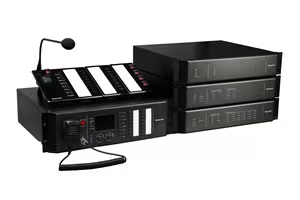
PA and Voice Alarm System Design — What It Involves
Life-safety voice alarm systems that do not achieve the STI-PA or sound pressure level thresholds required by BS EN 50849:2017 cannot be formally commissioned as compliant. Non-compliant systems present a legal liability and, in occupied buildings, may not satisfy insurers or building regulators. Failures discovered at commissioning stage require loudspeaker layout changes, DSP reconfiguration and re-measurement, all at significant cost and programme delay.
PA and voice alarm system design involves specifying the loudspeaker type, layout, aiming angles and drive levels required to achieve a minimum STI-PA of 0.45 in every occupied zone, alongside the A-weighted sound pressure levels defined by BS EN 50849:2017 and, in healthcare settings, HTM 08-01. The design process uses electroacoustic prediction software to model speech intelligibility and level distribution in the proposed space before any equipment is installed, allowing the layout to be optimised and documented for contractor installation and commissioning.
Why is acoustic design important for your PA and voice alarm system?
Life-safety compliance from day one
BS EN 50849:2017 requires a minimum STI-PA of 0.45 in all occupied zones for a voice alarm system to be classified as compliant. Acoustic design before installation confirms that the proposed loudspeaker layout achieves this threshold in the as-built acoustic conditions, avoiding the cost and programme delay of a non-compliant commissioning result.
Intelligibility in reverberant spaces
Large reverberant spaces, including atria, transport concourses, covered walkways and sports facilities, consistently produce STI-PA failures when loudspeaker layouts are based on coverage area alone rather than modelled intelligibility. Acoustic design identifies problematic zones before installation, allowing the layout to be adjusted while changes are still low cost.
Regulatory and insurer confidence
A formally commissioned and documented PA and voice alarm system, with STI-PA measurement records and a commissioning report, satisfies the requirements of the Responsible Person under fire safety legislation, provides evidence for building control sign-off and supports the case with insurers that life-safety systems meet their stated performance obligations.
Coordination with M&E and fire design
A voice alarm system that fails to achieve the minimum STI-PA of 0.45 required by BS EN 50849:2017 is not compliant with life-safety requirements and may prevent a building from achieving its occupancy certificate. The Responsible Person carries legal accountability for system performance; an independently verified commissioning report documenting measured STI-PA values across the coverage zone provides the evidence required to demonstrate compliance.
What acoustic and system standards govern PA and voice alarm systems?
PA and voice alarm systems must provide clear, intelligible announcements across occupied areas, particularly in emergency situations. Design is typically guided by BS EN 60849, BS 5839-8 and relevant fire safety requirements, with focus on speech transmission, coverage, reliability and system integration
Ongoing support and re-commissioning
Acoustic modelling and loudspeaker layout
We model the acoustic characteristics of each zone, including reverberation time, background noise level and room geometry, and use electroacoustic prediction software to determine the loudspeaker type, spacing, aiming and drive level required to achieve STI-PA of 0.45 or above and the required sound pressure level throughout each occupied space. The design is documented as a layout drawing with supporting calculations for contractor installation.
DSP and system configuration
We specify the digital signal processing requirements, including equalisation, delay and limiting, needed to optimise speech intelligibility in each zone. Where the system serves zones with different acoustic conditions, for example a reverberant concourse adjacent to a treated waiting area, zone-specific processing is specified to achieve consistent STI-PA performance without over-driving quieter areas.
Commissioning, measurement and certification
On completion of installation and system configuration, we carry out STI-PA measurements in each occupied zone using calibrated instrumentation and the test methodology defined in IEC 60268-16. Measured values are recorded in a commissioning report confirming that the system achieves BS EN 50849:2017 compliance, including sound pressure levels, STI-PA results and system integrity checks.
Ongoing support and re-commissioning
Where building use changes, new zones are added, or periodic re-testing is required to satisfy maintenance contracts or building safety obligations, we carry out follow-up STI-PA measurements and, where performance has degraded, identify the cause and the corrective action required to restore compliance.
Questions
Find answers to common questions about noise assessment and compliance.
BS EN 50849:2017 and Approved Document B require voice alarm systems in certain building types and above defined occupancy thresholds, including large assembly buildings, transport hubs and high-rise residential blocks. The Regulatory Reform (Fire Safety) Order 2005 places responsibility on the Responsible Person to ensure that the means of raising a fire alarm is adequate for the building's occupants. Where a voice alarm system is required, it must comply with BS EN 50849:2017 to be accepted by building control and fire authorities.
STI-PA (Speech Transmission Index for Public Address) is a measure of speech intelligibility rated from 0 to 1, where 0.45 is the minimum value required by BS EN 50849:2017 for voice alarm systems. Values below 0.45 indicate that evacuation instructions will not be reliably understood in the as-built acoustic conditions, which is a non-compliance. Values approaching 0.6 and above represent good intelligibility. STI-PA is affected by the ratio of direct to reverberant sound energy and by background noise level, both of which are addressed in the acoustic design.
Yes. We assess the current system performance by measuring STI-PA and sound pressure levels in all occupied zones and comparing results against BS EN 50849:2017 thresholds. Where the system falls short, we identify whether the shortfall can be addressed through DSP reprogramming, loudspeaker repositioning or supplementary loudspeaker installation. A commissioning report confirming the upgraded performance is produced on completion of remedial works.
STI-PA commissioning on a typical office or healthcare building of 5,000 to 15,000 m² takes one to two days on site, subject to zone access. Larger transport or entertainment venues may require two to four days. The commissioning programme is agreed with the contractor and the site manager to minimise disruption to the building programme or ongoing occupation. The commissioning report is typically issued within five working days of the site visit.
Yes. In reverberant spaces where STI-PA is marginal or failing, reducing reverberation time through acoustic treatment can significantly improve intelligibility. Adding absorption to walls, ceilings or suspended baffles shortens the reverberant tail and increases the direct-to-reverberant ratio at each listener position. Where reverberation time exceeds approximately 1.5 seconds, acoustic treatment and loudspeaker layout optimisation together typically achieve greater STI-PA improvement than either measure alone.
Need more information?
Reach out to discuss your assessment needs.
Talk to an Acoustic Consultant
Looking for advice on building acoustics, noise control, environmental assessments, or compliance? Send us a message and we'll respond as soon as possible.



.webp)