
Reverberation Surveys
Without measurement, treatment specifications, compliance assessments and acoustic diagnoses rest on assumptions rather than evidence; reverberation surveys replace that uncertainty with measured data.
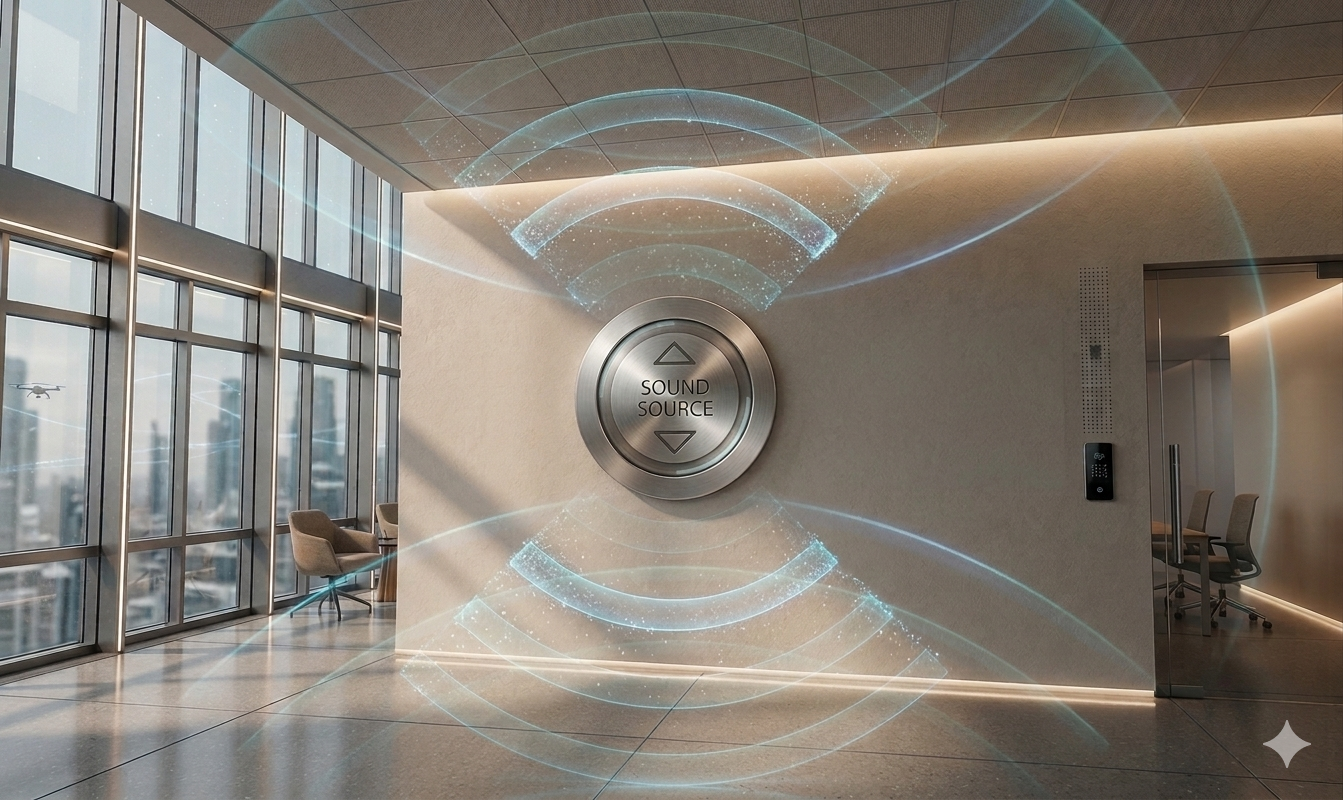

Reverberation Surveys — What They Involve
Reverberation surveys are commissioned when a room's acoustic performance needs to be quantified, whether for BB93 compliance in a school, HTM 08-01 assessment in a healthcare facility, a BREEAM HEA 05 submission or simply to diagnose an acoustic complaint before specifying remediation. Without measurement, any treatment programme rests on assumptions rather than data, routinely leading to over-specified or ineffective results.
The survey involves in-situ measurement of reverberation time at octave band frequencies to BS EN ISO 3382. Measured values are compared against the applicable criteria and presented in a report that identifies any shortfall, quantifies the treatment needed to address it and provides the evidence record required for compliance sign-off.
Why commission a reverberation survey?
Baseline evidence
A measured baseline shows exactly how a room is performing before any treatment is specified. It replaces guesswork with data and provides the accurate starting point for a treatment specification that is both effective and cost-efficient.
Compliance verification
BB93, HTM 08-01 and BREEAM HEA 05 all require reverberation time measurement evidence to demonstrate that a space meets its acoustic performance standard. Reverberation surveys produce the measurement record needed for compliance sign-off and assessor submission.
Retrofit planning
For existing rooms with acoustic complaints, a survey identifies which frequency bands are most problematic and where absorption is needed, allowing treatment to be targeted and budgeted accurately rather than applied broadly across every surface.
Dispute resolution
Survey data measured in an existing building provides an objective baseline for treatment specifications, planning submissions and condition discharge, replacing estimates based on calculation alone. Where rooms are approaching the end of an acoustic treatment lifecycle or have been refurbished, resurveying confirms whether performance still meets the applicable standard and whether additional treatment is required before compliance is at risk and a formal remediation programme becomes necessary.
What standards govern reverberation surveys?
Reverberation surveys are carried out to BS EN ISO 3382-1:2009 for auditoria, concert halls, theatres and performance spaces, and to BS EN ISO 3382-2:2008 for offices, classrooms, healthcare spaces and other occupied buildings. Both standards specify measurement methodology, source and receiver positioning, frequency bands and the calculation of reverberation time (T20, T30) and early decay time (EDT). Results are expressed as octave-band values across the frequency range 125 Hz to 4 kHz, or wider where the application requires it.
Survey results are evaluated against the performance criteria in the applicable sector standard. For school buildings, BB93 specifies RT targets by room type. For healthcare facilities, HTM 08-01 sets criteria for clinical and patient areas. For offices and other non-residential buildings, BREEAM HEA 05 and sector guidance documents provide the benchmarks. Where a space fails to meet the applicable criteria, survey data forms the basis for a treatment specification. For BREEAM submissions, the survey report is structured to meet the evidence format requirements of the relevant BREEAM scheme.
Report and recommendations
Survey planning
We review the room layout, size and intended use and confirm the measurement positions required by BS EN ISO 3382. Access requirements, background noise conditions and the applicable performance criteria are agreed with the site manager before attendance.
On-site measurement
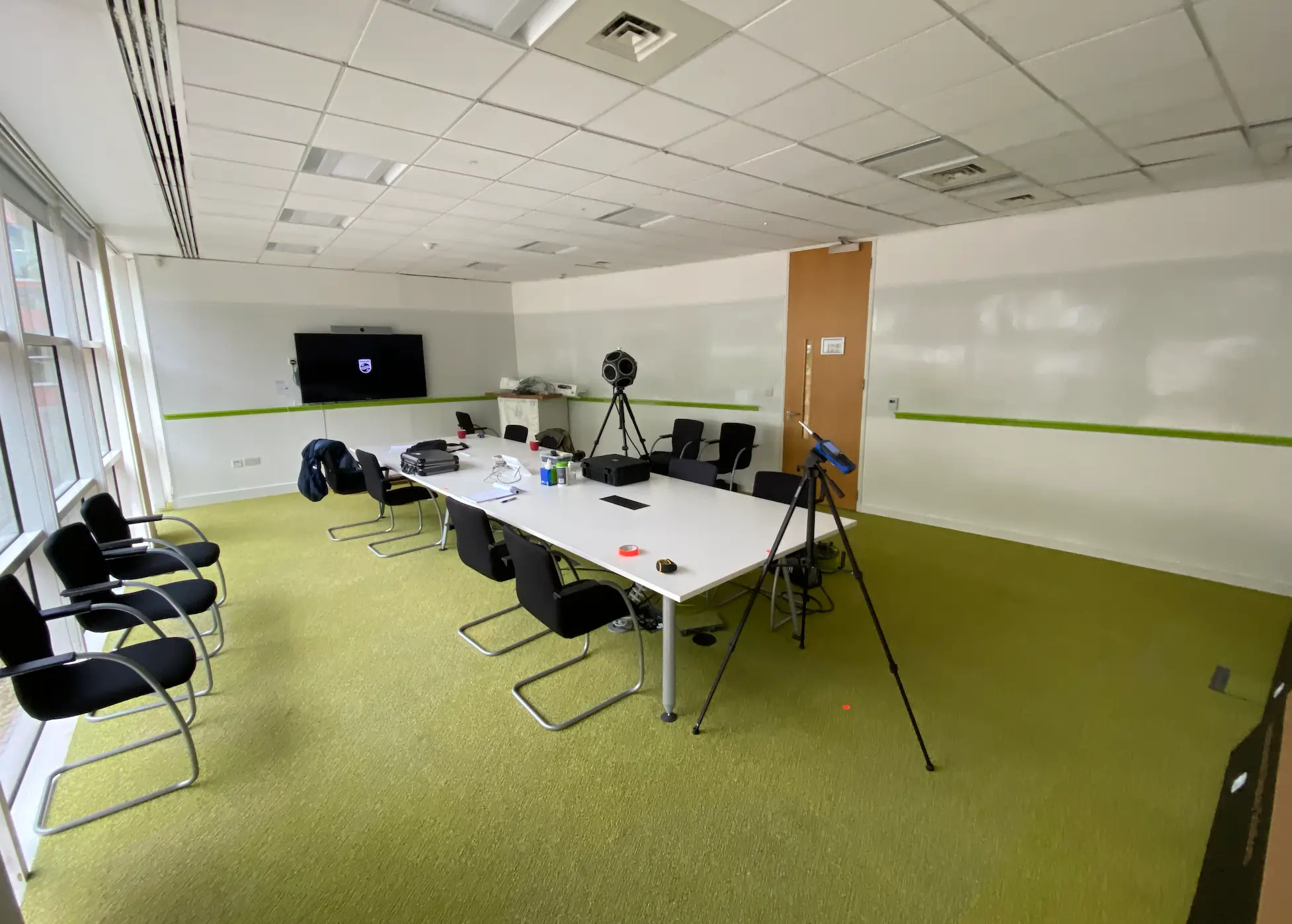
Using calibrated loudspeakers and measurement equipment, we measure reverberation time at octave band frequencies from 125 Hz to 4 kHz at multiple positions across the room in line with BS EN ISO 3382.
Data analysis
Measured values are averaged across positions and compared against the applicable performance standard. Any shortfall is quantified and the additional absorption area required to achieve the target is calculated for inclusion in the treatment recommendation.
Report and recommendations
A measurement report is issued documenting the measured values, the comparison against the applicable standard and any treatment recommendations. It can be used to support a planning condition discharge, a BREEAM submission or a design brief for acoustic treatment work.
Questions
Find answers to common questions about noise assessment and compliance.
You need a reverberation survey when a space must be assessed for compliance with BB93, HTM 08-01 or BREEAM, when planning acoustic treatment and needing a measured baseline before specifying, or when there are acoustic complaints that need to be objectively diagnosed and evidenced before any remediation work is commissioned.
Most single-room surveys take two to four hours on site including set-up, measurement and initial data processing. A multi-room programme such as a school acoustic audit typically takes a full day. Duration depends on the number of rooms, access arrangements and background noise conditions at the time of the survey.
A reverberation survey measures how sound decays within a room, characterising its internal acoustic quality. A noise survey measures sound pressure levels from external or internal sources affecting occupants. Both use calibrated measurement equipment but they address different acoustic questions and serve different compliance and design purposes.
Reverberation measurements require background noise to be below a defined threshold relative to the measurement signal. In practice, most rooms can be surveyed during quiet periods, such as early mornings, evenings or weekends, without the space needing to be fully vacated. We agree the timing with the site manager before confirming the survey date.
You receive a measurement report documenting the reverberation time values by octave band and room position, a comparison against the applicable performance standard and, where relevant, recommendations for the treatment needed to achieve the target. Reports are issued within five working days of the survey.
Need more information?
Reach out to discuss your assessment needs.
Talk to an Acoustic Consultant
Looking for advice on building acoustics, noise control, environmental assessments, or compliance? Send us a message and we'll respond as soon as possible.


.webp)