
Sound Insulation Testing
Part E pre-completion testing is a mandatory requirement for new-build and converted dwellings; building control cannot issue a completion certificate until test results demonstrate compliance.

Sound Insulation Testing — What It Involves
Dwellings with inadequate sound insulation expose occupants to noise from neighbouring properties, disrupting sleep and everyday life. Without pre-completion testing, poor-performing separating walls and floors are not detected until after occupation, by which point remediation requires stripping out completed finishes and causes significant programme delay and cost.
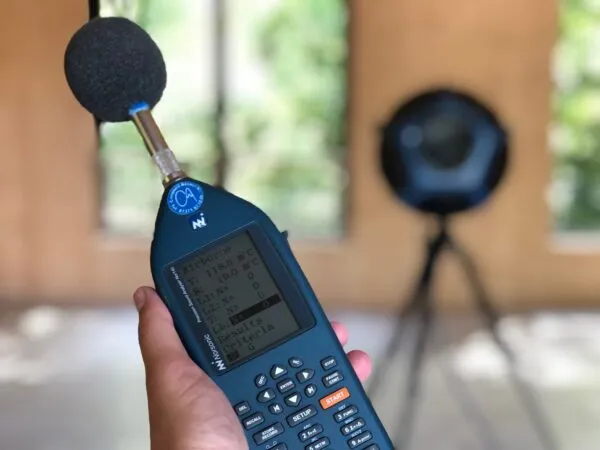
Sound insulation testing measures the acoustic performance of separating walls and floors between completed dwellings using calibrated loudspeakers, tapping machines and sound level meters. Airborne performance is expressed as DnTw + Ctr and impact performance as L’nTw, both assessed against Part E minima using BS EN ISO 16283 methodology.
Why is sound insulation testing important for your development?
Building control sign-off
Part E pre-completion testing is mandatory under the Building Regulations for new-build and converted dwellings. Building control bodies cannot issue a completion certificate until test results are submitted and accepted, making timely testing a critical item on the handover programme.
Occupant wellbeing
Sound insulation that meets Part E minima protects residents from noise generated in adjoining dwellings, including impact sound from footfall and airborne noise from speech and music. Adequate performance is directly linked to sleep quality, concentration and long-term residential satisfaction.
Defect detection before handover
Testing at practical completion identifies separating elements that fail before the site is handed over and finishes are signed off. Addressing shortfalls while the development is still live is significantly less disruptive and costly than remediation following occupation and complaint.
Developer audit trail
A pre-completion test failure prevents a dwelling from being occupied until the separating element is remediated and retested, with potential knock-on effects for practical completion, mortgage offers and staged payment schedules. Where failures are caused by flanking transmission through completed structure, remediation is disruptive and costly. Early involvement of an acoustic consultant at specification stage reduces the probability of failure and the programme risks that follow.
What is Part E of the Building Regulations and BS EN ISO 16283?
Pre-completion sound insulation testing is carried out under the requirements of Approved Document E (Part E of the Building Regulations) using the measurement methodology in BS EN ISO 16283-1:2014 for airborne sound insulation and BS EN ISO 16283-2:2015 for impact sound insulation. These standards replaced the earlier BS EN ISO 140 series and specify in-situ measurement procedure, loudspeaker and tapping machine placement, frequency range, averaging positions and the calculation of DnTw + Ctr for airborne and L'nTw for impact.
Approved Document E sets the minimum performance values: DnTw + Ctr ≥ 45 dB and L'nTw ≤ 62 dB for new-build dwellings, and DnTw + Ctr ≥ 43 dB and L'nTw ≤ 64 dB for residential conversions. Test results are submitted to the relevant building control body and form part of the completion documentation. Where required for BREEAM HEA 05 credit evidence, test reports are structured to meet the assessor's format requirements. Results below the applicable minimum require the separating element to be remediated and retested before completion sign-off can be issued.
Report and submission
Programme coordination
We agree the test schedule with the developer, contractor and building control body before attending site, confirming which separating elements require testing and how many tests are required. Part E requires a minimum of two tests per separating element type, rising to one test per ten dwellings on larger developments. Early coordination prevents programme delays caused by incomplete finishes or inaccessible test rooms.
Site testing
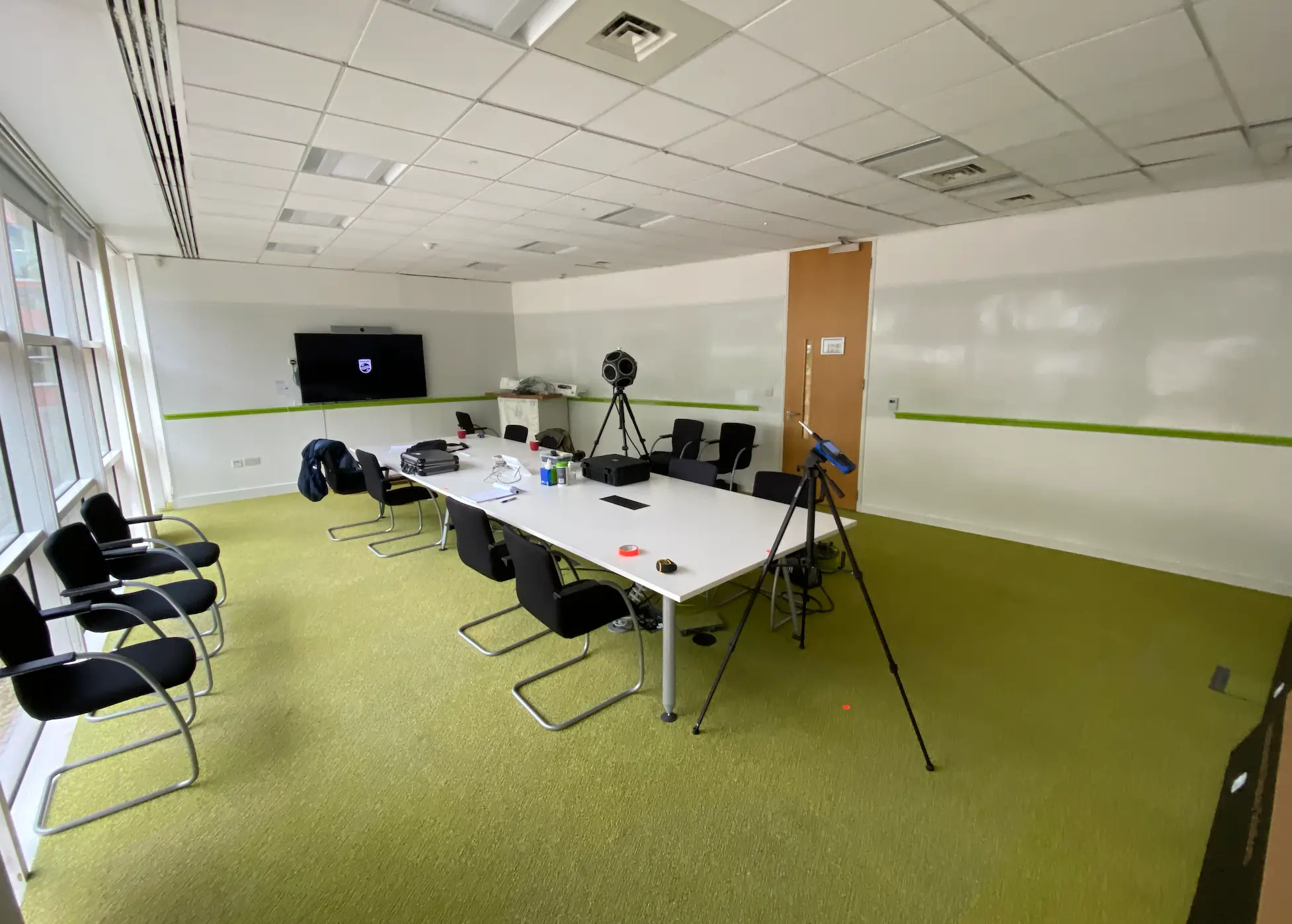
Using calibrated loudspeakers, tapping machines and sound level meters, our consultants measure airborne and impact sound insulation across all required test combinations in accordance with BS EN ISO 16283. All equipment carries current calibration certificates and testing is conducted by IOA-registered acoustic consultants.
Part E assessment
Measured data is processed to derive DnTw + Ctr values for airborne sound and L’nTw values for impact sound, and each result is assessed against the relevant Part E performance standard. Where a test fails, we identify the most likely cause and advise on targeted remedial options before leaving site.
Report and submission
A full pre-completion testing report is produced, formatted for submission to the building control body, documenting test methodology, equipment calibration records, measured results and compliance status for each combination. Reports are typically issued within 48 hours of site attendance so that handover programmes are not held up.
Questions
Find answers to common questions about noise assessment and compliance.
Part E testing is required for most new-build dwellings and conversions involving a material change of use to create new residential units, including flat conversions, house divisions and commercial-to-residential schemes. Testing is not required where Robust Details registered constructions are used throughout, but registration and site inspection are still required. The building control body will confirm requirements at project start.
In most cases we can attend site within a few days of instruction and issue the test report within 48 hours of completing measurements. We accommodate short-notice bookings where a handover date or building control deadline is imminent and can often attend the same week. The testing programme is agreed with the building control body at the outset.
Part E of the Building Regulations (Approved Document E) sets the performance standards and is enforced by the relevant building control body, either a local authority or an Approved Inspector. Measurements are carried out to BS EN ISO 16283, which replaced BS EN ISO 140, and results are rated using the single-number methods in BS EN ISO 717.
For airborne testing, a calibrated loudspeaker generates a continuous broadband signal in the source room while sound levels are measured simultaneously across one-third octave bands. For impact testing, a calibrated tapping machine operates on the floor above while levels are recorded in the room below. Rooms must be complete, clear of furniture and with doors and windows closed.
If a result falls below the Part E minimum, we identify the most likely cause, typically flanking transmission, incomplete sealing around services penetrations or insufficient mass in the construction, and advise on targeted remedial works before leaving site. Once remediation is complete, the element must be retested and results resubmitted to the building control body. We return at short notice to carry out retesting.
Need more information?
Reach out to discuss your assessment needs.
Talk to an Acoustic Consultant
Looking for advice on building acoustics, noise control, environmental assessments, or compliance? Send us a message and we'll respond as soon as possible.


.webp)