
Sound Proofing Design
Soundproofing systems that are not designed around measured acoustic targets regularly fail to achieve the isolation the client expects; specifying the correct combination of mass, decoupling and absorption before construction eliminates the cost and disruption of remediation once the space is built and in use.
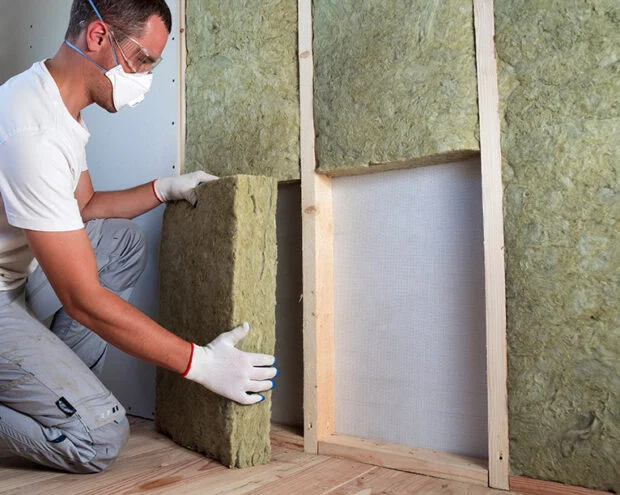

Soundproofing Design — What It Involves
Soundproofing a space is not simply a matter of adding more layers of board or filling cavities with foam. The acoustic performance of a construction is determined by the weakest element in the assembly, which is often not the main partition but a flanking path through the floor slab, ceiling void, services duct or door frame. A soundproofing system designed without identifying and addressing these weak points will not achieve the isolation target regardless of how heavy the main wall or floor construction is.
Soundproofing design involves setting a specific isolation target, expressed as a weighted sound reduction index (Rw or DnT,w for airborne sound, or LnT,w for impact sound), and specifying the construction assemblies needed to achieve it. The design addresses the primary partition, all flanking paths, structural isolation where required, door and window specifications, and service penetration sealing details. For critical applications such as recording studios and home cinemas, the design may include a room-within-a-room construction using resilient mounts to decouple the inner shell from the surrounding structure.
Why does professional soundproofing design matter?
Achieving a defined isolation target
Without a defined target, expressed in weighted dB, there is no objective basis for selecting the construction and no way to verify on completion that the space performs as the client expected. Soundproofing design sets the target before construction begins, specifies the assemblies required to achieve it and provides the measured result that confirms it has been met, removing uncertainty from what is often a significant construction investment.
Addressing flanking and weak points
The most common reason soundproofing fails is not the main partition but a flanking path that was not identified or addressed in the design. Flanking transmission through floor slabs, ceiling voids, lightweight internal partitions, services risers and door frames routinely reduces achieved isolation by 10 dB or more relative to the theoretical performance of the primary construction. Professional design identifies all significant flanking paths and specifies the details needed to control them.
Cost certainty before construction
Specifying the correct construction before work begins is substantially cheaper than discovering a performance shortfall after the space is built. Retrospective soundproofing improvements in an occupied or finished space require access to the structure, removal of finishes and additional construction that typically costs several times more than the original work. A design brief agreed before construction eliminates this risk.
Verified performance on completion
Soundproofing solutions that fail to achieve the specified performance are frequently the result of inadequate attention to flanking transmission paths and structural connections, rather than any deficiency in the primary construction. A specification that addresses every identifiable transmission path — including junctions, penetrations and floating floor continuity — delivers the required performance without the additional cost and disruption of remediation after the work is complete.
What acoustic standards apply to soundproofing design?
Soundproofing design for specialist spaces is governed by performance targets that depend on the space type and use, rather than a single mandatory standard. For residential applications — recording studios, home cinemas and music rooms within dwellings — Approved Document E provides a minimum framework, but the isolation required typically exceeds Part E values substantially. The degree of isolation is calculated from the maximum internal sound level in the source space and the minimum acceptable level in the receiving space, expressed as DnTw or Rw values measured to BS EN ISO 16283-1:2014.
For commercial soundproofing — plant rooms, recording studios, broadcast facilities and music rehearsal spaces — performance targets are project-specific and agreed with the client before specification begins. The specification addresses all transmission paths: primary constructions, floating floors, isolated ceilings, resilient isolation at structural interfaces and acoustically sealed services penetrations. Where post-installation testing is required, measurements are carried out to BS EN ISO 16283-1:2014. The design must account for the practical limits of structural isolation and for flanking transmission through connected structure that cannot be fully decoupled.
Post-construction measurement and sign-off
Performance target and brief review
We agree with the client the specific isolation target required, expressed as a weighted DnT,w for airborne sound and, where impact transmission is also a concern, as a weighted LnT,w. The target is set in relation to the intended use of the space, the noise source to be attenuated and any regulatory, lease or planning requirements that apply. Where relevant, we carry out a site survey to characterise the existing construction and identify any constraints that will affect the specification.
Construction specification and flanking analysis
We specify the primary partition construction required to achieve the isolation target, selecting from double-leaf masonry, high-performance drywall systems, floating floor constructions, suspended ceiling systems and proprietary acoustic assemblies as appropriate. All significant flanking paths are identified and specified: floor and ceiling junctions, abutting walls, service penetrations, doors and windows. Where critical performance is required, a room-within-a-room configuration using resilient mounts or hangers is specified to decouple the inner shell from the building structure.
Detail design and contractor coordination
We produce construction details and a specification document for issue to the contractor, covering all elements of the soundproofing system, including resilient layer specification, discontinuity requirements at junctions, sealing of penetrations and the installation quality standards that must be maintained to achieve the design performance. We advise the contractor on critical workmanship points and, where required, carry out site inspections during construction to confirm that the specification is being followed.
Post-construction measurement and sign-off
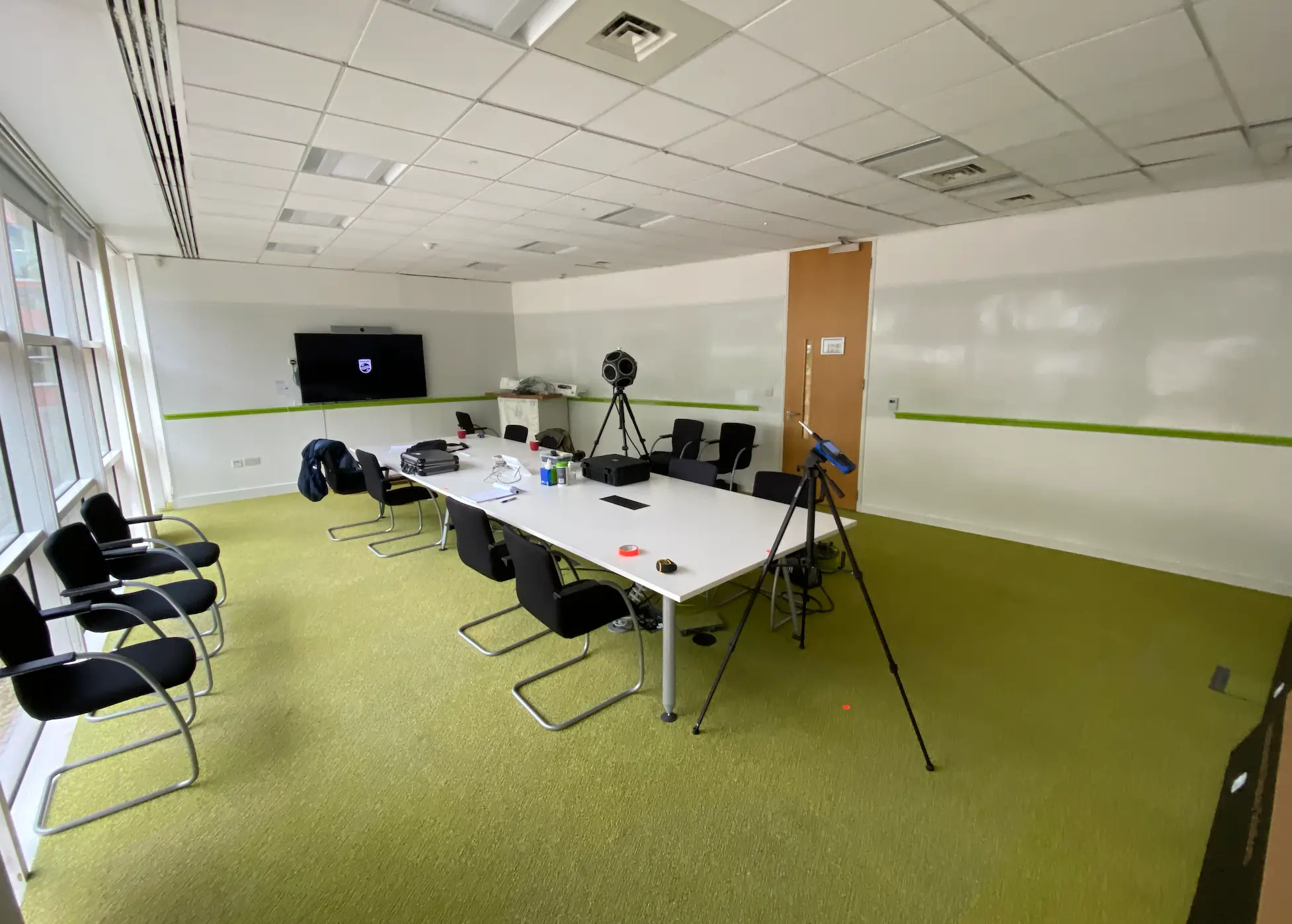
On completion of construction, we carry out field measurements of airborne and, where applicable, impact sound insulation to BS EN ISO 16283, using calibrated instrumentation and the measurement methodology appropriate to the space type. Results are compared against the design target and any applicable regulatory standard. A test report documenting the measured performance is issued to the client as evidence of compliance or as a record of the achieved specification.
Questions
Find answers to common questions about noise assessment and compliance.
The required level of soundproofing depends on the noise source to be attenuated, the use of the receiving space and the acceptable residual noise level. As a general reference, a DnT,w of 45 dB is roughly equivalent to the Approved Document E requirement for separating walls in new dwellings and will make a loud conversation in an adjacent room difficult but not impossible to hear. A DnT,w of 55 dB will typically render loud music in an adjacent room barely audible. A DnT,w of 65 dB or above, achievable only with a room-within-a-room approach, is required for recording studios and other critical listening environments. We advise on the appropriate target based on measured source levels and the required residual level in the protected space.
Soundproofing controls the transmission of sound between spaces, reducing how much noise passes through walls, floors and ceilings from one room to another. Acoustic treatment controls how sound behaves within a room, managing reverberation, reflections and frequency balance for listening, recording or speech. Adding foam panels or acoustic tiles to a wall reduces reverberation inside the room but has no meaningful effect on sound transmission to adjacent spaces. A room that is both well soundproofed and well treated acoustically requires both isolation construction and internal acoustic treatment, each designed for its respective purpose.
It depends on the current construction and the target performance. Modest improvements of 5 to 10 dB can often be achieved by adding mass to existing partitions, improving door and window seals and addressing gaps in the building fabric. Improvements beyond this level typically require decoupling the partition from the structure, which involves rebuilding the wall or floor assembly with resilient mounts or floating floor construction. We assess the existing construction and the target performance to advise on whether a non-invasive approach is feasible or whether structural decoupling is necessary.
The most common cause is flanking transmission through a path that was not addressed in the specification. Even a small gap around a service pipe, a continuous floor slab beneath a floating wall or a single rigid connection between the inner shell and the surrounding structure can reduce achieved isolation by 10 to 15 dB. Poor workmanship, including incomplete sealing of penetrations, broken resilient layers and accidental rigid connections, is the second most common cause. We design to address both flanking paths and workmanship risks, and carry out post-construction measurement to confirm that the specified performance has been achieved before the space is handed over.
This depends on the nature of the work. Changes to the thermal or structural elements of the building fabric typically require building control notification. Approved Document E requires pre-completion sound insulation testing in new dwellings and material change of use conversions. For work in existing buildings that does not constitute a material change of use, building control notification may not be required, but we advise on any applicable requirements for the specific project. Where a planning condition requires a specified level of sound insulation, post-construction measurement and a test report will be required to discharge the condition regardless of building regulations status.
Need more information?
Reach out to discuss your assessment needs.
Talk to an Acoustic Consultant
Looking for advice on building acoustics, noise control, environmental assessments, or compliance? Send us a message and we'll respond as soon as possible.


.webp)